| Sio | n-Sio | p-Sio | SiC | SiO | SiO2 | SiO2-nH2O | Si3N4 | SiGex | SiON |
| Al2SiO5 | Al2Si2O13 | Be2SiO4 | CaTiSiO5 | K2SiO3 | MgSiO3 | Mg3Si4O10(OH)2 | Na2Si3O7 | ZrSiO4 | Silicic Acid |
| PDMS | PMPS | Soda-lime Glass | NIST 610 | NIST 612 | NIST 614 | Ba-Borosilicate | Silica Gel | Colloidal SiO2 |
XPS Spectra
Silicon (Si) Compounds
The XPS Spectra section provides raw and processed survey spectra, chemical state spectra, BE values, FWHM values, and overlays of key spectra.
Atom% values from surveys are based on sample, as received, and Scofield cross-sections. Atom% values are corrected for IMFP and PE.
Peak-fits are guides for practical, real-world applications. Peak-fits are not fully optimized or designed to test any theory.
Silicon Nitride (Si3N4 – LP-CVD film, 1μ)
Survey, Peak-fits, BEs, FWHMs, and Peak Labels
| → Periodic Table | → Six (6) BE Tables |
| Survey Spectrum from Si3N4 Freshly exposed bulk, Flood gun is ON, C (1s) BE = 285.0 eV, Ag (3d5/2) FWHM = 1.3 eV |
|
     |
|
|
|
|
| → Periodic Table | → Six (6) BE Tables |
| Si (2p) Spectrum from Si3N4 – Raw Fresh exposed bulk, Flood gun is ON, C (1s) BE = 285.0 eV, Ag FWHM = 0.75 eV |
Si (2p) Spectrum from Si3N4 – Peak-Fit Freshly exposed bulk, Flood gun is ON, C (1s) BE = 285.0 eV, Ag FWHM = 0.75 eV |
 |
 |
|
|
|
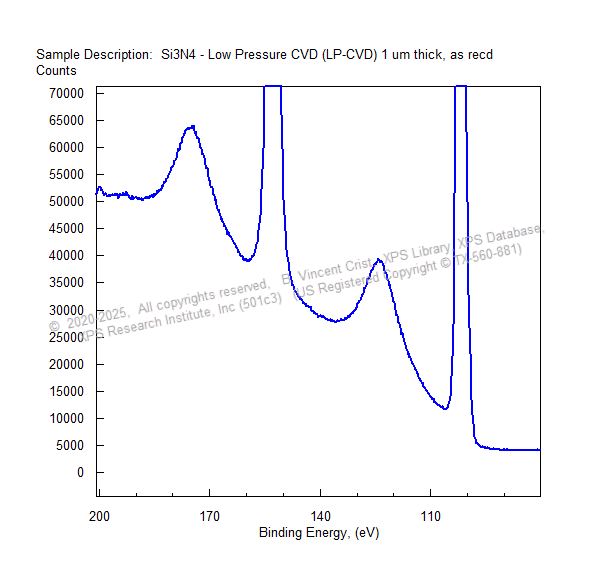
| Si (2p-2s) Spectrum from Si3N4 – Extended Fresh exposed bulk, Flood gun is ON, C (1s) BE = 285.0 eV, Ag FWHM = 0.75 eV |
Si (2p) Spectrum from Si3N4 – Raw – Expanded Freshly exposed bulk, Flood gun is ON, C (1s) BE = 285.0 eV, Ag FWHM = 0.75 eV |
 |
 |
|
|
|
| → Periodic Table | → Six (6) BE Tables |
| N (1s) Spectrum from Si3N4 – Raw Freshly exposed bulk, Flood gun is ON, C (1s) BE = 285.0 eV, Ag FWHM = 0.75 eV |
N (1s) Spectrum from Si3N4 – Peak-fit Freshly exposed bulk, Flood gun is ON, C (1s) BE = 285.0 eV, Ag FWHM = 0.75 eV |
 |
 |
|
|
|
| → Periodic Table | → Six (6) BE Tables |
| N (1s) Spectrum from Si3N4 – Extended Freshly exposed bulk, Flood gun is ON, C (1s) BE = 285.0 eV, Ag FWHM = 0.75 eV |
N (1s) Spectrum from Si3N4 – Raw – Expanded Freshly exposed bulk, Flood gun is ON, C (1s) BE = 285.0 eV, Ag FWHM = 0.75 eV |
 |
 |
|
|
|
| → Periodic Table | → Six (6) BE Tables |
| C (1s) Spectrum from Si3N4 – Peak-fit – As measured Freshly exposed bulk, Flood gun is ON, C (1s) BE = 284.21 eV, Ag FWHM = 0.75 eV |
C (1s) Spectrum from Si3N4 – Peak-Fit – Corrected Freshly exposed bulk, Flood gun is ON, C (1s) BE = 285.0 eV, Ag FWHM = 0.75 eV |
 |
 |
| → Periodic Table | → Six (6) BE Tables |
| Si (2s) Spectrum from Si3N4 – Raw Freshly exposed bulk, Flood gun is ON, C (1s) BE = 285.0 eV, Ag FWHM = 0.75 eV |
Si (2s) Spectrum from Si3N4 – Peak-Fit Freshly exposed bulk, Flood gun is ON, C (1s) BE = 285.0 eV, Ag FWHM = 0.75 eV |
 |
 |
|
|
|
| → Periodic Table | → Six (6) BE Tables |
| N (KLL) Auger Spectrum from Si3N4 – Raw Freshly exposed bulk, Flood gun is ON, C (1s) BE = 285.0 eV, Ag FWHM = 0.75 eV |
Valence Band Signals from Si3N4 – Raw Freshly exposed bulk, Flood gun is ON, C (1s) BE = 285.0 eV, Ag FWHM = 0.75 eV |
 |
 |
|
|
|
| Overlays |
|
| → Periodic Table | → Six (6) BE Tables |
| Valence Band Spectra – Overlay of Sio and Si3N4 Freshly exposed bulk, Flood gun is ON, C (1s) BE = 285.0 eV, Ag FWHM = 0.75 eV |
Si (2p) Spectra – Overlay of Sio and Si3N4 Freshly exposed bulk, Flood gun is ON, C (1s) BE = 285.0 eV, Ag FWHM = 0.75 eV |
 |
 |
|
|
|
| → Periodic Table | → Six (6) BE Tables |
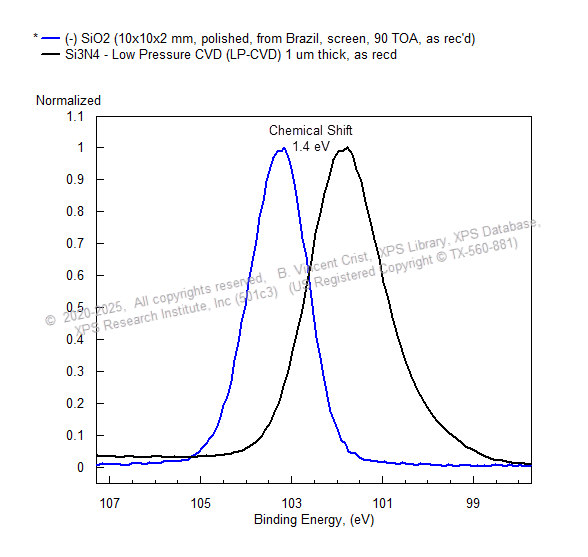
| Si (2p) Spectra – Overlay of SiO2 and Si3N4 Freshly exposed bulk, Flood gun is ON, C (1s) BE = 285.0 eV, Ag FWHM = 0.75 eV |
Si (2p) Spectra – Overlay of SiC and Si3N4 Freshly exposed bulk, Flood gun is ON, C (1s) BE = 285.0 eV, Ag FWHM = 0.75 eV |
 |
 |
|
End-of-spectra Price to purchase raw data sets: Transmission Function Tests |
|
| December 2015 – Transmission Function of Thermo K-Alpha Plus |
| → Periodic Table |
| Survey Spectra of Ion Etched Copper (Cr), PEs = 50, 100, 150 and 200 eV |
 |
|
|
| → Periodic Table |
| March 2016 – Transmission Function of Thermo K-Alpha Plus |
| Survey Spectra of Ion Etched Copper (Cr), PEs = 100, 150 and 200 eV |
 |
|
|
| → Periodic Table |
| August 2019 – Transmission Function of Thermo K-Alpha Plus |
| Survey Spectra of HOPG (C), PEs = 20, 50, 100 and 200 eV |
 |
|
|
| → Periodic Table |
| January 2022 – Transmission Function of Thermo K-Alpha Plus |
| Survey Spectra of Ion Etched Copper (Cr), PEs = 100, 120, 140, 160, 180 and 200 eV |
 |
Six (6) Chemical State Tables of Si (2p) BEs
- The XPS Library Spectra-Base
- PHI Handbook
- Thermo-Scientific Website
- XPSfitting Website
- Techdb Website
- NIST Website
Notes of Caution when using Published BEs and BE Tables from Insulators and Conductors:
-
- Accuracy of Published BEs
- The accuracy depends on the calibration BEs used to calibrate the energy scale of the instrument. Cu (2p3/2) BE can vary from 932.2 to 932.8 eV for old publications
- Different authors use different BEs for the C (1s) BE of the hydrocarbons found in adventitious carbon that appears on all materials and samples. From 284.2 to 285.3 eV
- The accuracy depends on when the authors last checked or adjusted their energy scale to produce the expected calibration BEs
- There are uncertainties and error ranges in nearly all BEs
- Flood guns
- Worldwide Differences in Energy Scale Calibrations
- For various reasons authors still use older energy scale calibrations
- Some authors still adjust their energy scale so Cu (2p3/2) appears at 932.2 eV or 932.8 eV because this is what the maker taught them
- This range causes BEs in the higher BE end to be larger than expected
- This variation increases significantly above 600 eV BE
- Charge Compensation
- Samples that behave as true insulators normally require the use of a charge neutralizer (electron flood gun with or without Ar+ ions) so that the measured chemical state spectra can be produced without peak-shape distortions or sloping tails on the low BE side of the peak envelop.
- Floating all samples (conductive, semi-conductive, and non-conductive) and always using the electron flood gun is considered to produce more reliable BEs and is recommended.
- Charge Referencing Methods for Insulators
- Charge referencing is a common method, but it can produce results that are less reliable.
- When an electron flood gun is used, the BE scale will usually shift to lower BE values by 0.01 to 5.0 eV depending on your voltage setting. Normally, to correct for this flood gun induced shift, the BE of the hydrocarbon C (1s) peak maximum from adventitious carbon is used to correct for the charge induced shift.
- The hydrocarbon peak is normally the largest peak at the lowest BE.
- Depending on your preference or training, the C (1s) BE assigned to this hydrocarbon peak varies from 284.8 to 285.0 eV. Other BEs can be as low as 284.2 eV or as high as 285.3 eV
- Native oxides that still show the pure metal can suffer differential charging that causes the C (1s) and the O (1s) and the Metal Oxide BE to be larger
- When using the electron flood gun, the instrument operator should adjust the voltage and the XY position of the electron flood gun to produce peaks from a strong XPS signal (eg O (1s) or C (1s) having the most narrow FWHM and the lowest experimentally measured BE.
- Accuracy of Published BEs
Table #1
Si (2p) Chemical State BEs from: “The XPS Library Spectra-Base”
C (1s) BE = 285.0 eV for TXL BEs
and C (1s) BE = 284.8 eV for NIST BEs
| Element | Atomic # | Compound | As-Measured by TXL or NIST Average BE | Largest BE | Hydrocarbon C (1s) BE | Source |
| Si | 14 | Mg2Si | 98.5 eV | 285.0 eV | The XPS Library | |
| Si | 14 | NiSi (N*6) | 98.8 eV | 99.7 eV | 284.8 eV | Avg BE – NIST |
| Si | 14 | MoSi2 | 99.0 eV | 285.0 eV | The XPS Library | |
| Si | 14 | Si3H2 (N*4) | 99.0 eV | 284.8 eV | Avg BE – NIST | |
| Si | 14 | Si (p) | 99.2 eV | 285.0 eV | The XPS Library | |
| Si | 14 | Si – element | 99.5 eV | 285.0 eV | The XPS Library | |
| Si | 14 | Si (n) | 99.8 eV | 285.0 eV | The XPS Library | |
| Si | 14 | SiC (N*5) | 100.4 eV | 100.7 eV | 284.8 eV | Avg BE – NIST |
| Si | 14 | SiC | 100.5 eV | 285.0 eV | The XPS Library | |
| Si | 14 | Si2O | 100.8 eV | 285.0 eV | The XPS Library | |
| Si | 14 | Si3N4 (N*12) | 101.5 eV | 102.1 eV | 284.8 eV | Avg BE – NIST |
| Si | 14 | Si-O | 101.5 eV | 285.0 eV | The XPS Library | |
| Si | 14 | Si3N4 | 101.7 eV | 285.0 eV | The XPS Library | |
| Si | 14 | SiCN | 101.8 eV | 285.0 eV | The XPS Library | |
| Si | 14 | B4Si (N*1) | 101.9 eV | 284.8 eV | Avg BE – NIST | |
| Si | 14 | Pyrope | 102.1 eV | 285.0 eV | The XPS Library | |
| Si | 14 | HfSiOx | 102.3 eV | 285.0 eV | The XPS Library | |
| Si | 14 | Si2O3 | 102.3 eV | 285.0 eV | The XPS Library | |
| Si | 14 | Mica | 102.4 eV | 285.0 eV | The XPS Library | |
| Si | 14 | M-SiO3 (N*2) | 102.4 eV | 103.3 eV | 284.8 eV | Avg BE – NIST |
| Si | 14 | Si-PDMS | 102.4 eV | 102.6 eV | 285.0 eV | The XPS Library |
| Si | 14 | Al2SiO5 | 102.8 eV | 285.0 eV | The XPS Library | |
| Si | 14 | Aluminosilicates | 102.8 eV | 285.0 eV | The XPS Library | |
| Si | 14 | SiON | 102.8 eV | 103.0 eV | 285.0 eV | The XPS Library |
| Si | 14 | LiAlSi2O6 | 103.0 eV | 285.0 eV | The XPS Library | |
| Si | 14 | SiO2 | 103.1 eV | 285.0 eV | The XPS Library | |
| Si | 14 | SiO2 thermal | 103.2 eV | 285.0 eV | The XPS Library | |
| Si | 14 | SiO2 fused | 103.4 eV | 285.0 eV | The XPS Library | |
| Si | 14 | Si-(OH)4 Opal | 103.7 eV | 285.0 eV | The XPS Library |
Charge Referencing
- (N*number) identifies the number of NIST BEs that were averaged to produce the BE in the middle column.
- Binding Energy Scale Calibration expects Cu (2p3/2) BE = 932.62 eV and Au (4f7/2) BE = 83.98 eV. BE (eV) Uncertainty Range: +/- 0.2 eV
- Charge Referencing of insulators is defined such that the Adventitious Hydrocarbon C (1s) BE (eV) = 285.0 eV. NIST uses C (1s) BE = 284.8 eV
- Note: Ion etching removes adventitious carbon, implants Ar (+), changes conductivity of surface, and degrades chemistry of various chemical states.
- Note: Ion Etching changes BE of C (1s) hydrocarbon peak.
- TXL – abbreviation for: “The XPS Library” (https://xpslibrary.com). NIST: National Institute for Science and Technology (in USA)
Table #2
Si (2p) Chemical State BEs from: “PHI Handbook”
C (1s) BE = 284.8 eV

Copyright ©: Ulvac-PHI
Table #3
Si (2p) Chemical State BEs from: “Thermo-Scientific” Website
C (1s) BE = 284.8 eV
| Chemical state | Binding energy Si (2p) / eV |
|---|---|
| Si element | 99.4 |
| Si3N4 | 101.7 |
| ZrSiO4 | 102 |
| Organic Si | ~102 |
| Aluminosilicate | 102.7 |
| SiO2 | 103.5 |
Copyright ©: Thermo Scientific
Table #4
Si (2p) Chemical State BEs from: “XPSfitting” Website
Chemical State BE Table derived by Averaging BEs in the NIST XPS database of BEs
C (1s) BE = 284.8 eV

Copyright ©: Mark Beisinger
Table #5
Si (2p) Chemical State BEs from: “Techdb.podzone.net” Website
XPS Spectra – Chemical Shift | Binding Energy
C (1s) BE = 284.6 eV
XPS(X線光電子分光法)スペクトル 化学状態 化学シフト ケミカルシフト
|
||||||||||||||||||||||||||||||||||||||||||||||||||||||||||||||||
Histograms of NIST BEs for Si (2p) BEs
Important Note: NIST Database defines Adventitious Hydrocarbon C (1s) BE = 284.8 eV for all insulators.
| Histogram indicates: 99.4 eV for Sio based on 37 literature BEs Doping type is Unknown n-Si can be 0.6 eV smaller than p-Si |
Histogram indicates: 103.5 eV for SiO2 based on 54 literature BEs |
|
|
|
| Histogram indicates: 101.9 eV for Si3N4 based on 15 literature BEs | Histogram indicates: 99.2 eV for SiHx based on 16 literature BEs |
|
|
|
| Histogram indicates: 102.5 eV for -((CH3)2SiO)n– based on 7 literature BEs PDMS = Silicone Oil = Poly-dimethylsiloxane |
Histogram indicates: 100.6 eV for SiC based on 11 literature BEs |
|
|
|


Table #6
NIST Database of Si (2p) Binding Energies
NIST Standard Reference Database 20, Version 4.1
Data compiled and evaluated
by
Alexander V. Naumkin, Anna Kraut-Vass, Stephen W. Gaarenstroom, and Cedric J. Powell
©2012 copyright by the U.S. Secretary of Commerce on behalf of the United States of America. All rights reserved.
Important Note: NIST Database defines Adventitious Hydrocarbon C (1s) BE = 284.8 eV for all insulators.
| Element | Spectral Line | Formula | Energy (eV) | Reference |
|---|---|---|---|---|
| Si | 2p | Tm/Si | 98.00 | Click |
| Si | 2p | Tm/Si | 98.00 | Click |
| Si | 2p | Gd5Si3 | 98.10 | Click |
| Si | 2p | Si | 98.40 | Click |
| Si | 2p | Si/Ba | 98.40 | Click |
| Si | 2p | FeSi | 98.60 | Click |
| Si | 2p | GdSi | 98.60 | Click |
| Si | 2p | (-O)3Si(CH2)3NHC(O)(CH2)7C(O)OH/Si | 98.60 | Click |
| Si | 2p | Si | 98.70 | Click |
| Si | 2p | Er/Si | 98.70 | Click |
| Si | 2p | SiO2/Si | 98.70 | Click |
| Si | 2p | Tm/Si | 98.70 | Click |
| Si | 2p | Tm/Si | 98.70 | Click |
| Si | 2p | Tm/Si | 98.70 | Click |
| Si | 2p | TiSi2 | 98.80 | Click |
| Si | 2p | SiO2/Si | 98.80 | Click |
| Si | 2p | SiO2/Si | 98.80 | Click |
| Si | 2p | Au34Si66 | 98.80 | Click |
| Si | 2p | Si/(CH3(CH2)16C(O)O)2Cd | 98.80 | Click |
| Si | 2p | Si/AlAs | 98.89 | Click |
| Si | 2p | Si | 98.90 | Click |
| Si | 2p | Si | 98.90 | Click |
| Si | 2p | FeSi2 | 98.90 | Click |
| Si | 2p | Er/Si | 98.90 | Click |
| Si | 2p | Er/Si | 98.90 | Click |
| Si | 2p | SiO2/Si | 98.90 | Click |
| Si | 2p | Au59Si41 | 98.90 | Click |
| Si | 2p | Si/Y | 98.90 | Click |
| Si | 2p | Gd3Si5 | 98.90 | Click |
| Si | 2p | (-O)3Si(CH2)3NHC(O)(CH2)16CH3/Si | 98.90 | Click |
| Si | 2p | Si/(-O)3Si(CH2)3NHC(O)(CH2)11NO2 | 98.90 | Click |
| Si | 2p | Si:H | 98.90 | Click |
| Si | 2p | Si/SiO2/Zr | 98.90 | Click |
| Si | 2p | Zr1.02Si0.96Te1.02 | 98.90 | Click |
| Si | 2p | Si/Pt | 98.97 | Click |
| Si | 2p | Si/Pt | 98.97 | Click |
| Si | 2p | Si | 99.00 | Click |
| Si | 2p | FeSi | 99.00 | Click |
| Si | 2p | Tm/Si | 99.00 | Click |
| Si | 2p | Tm/Si | 99.00 | Click |
| Si | 2p | Tm/Si | 99.00 | Click |
| Si | 2p | Si/(-O)3Si(CH2)3NHC(O)(CH2)11NH2 | 99.00 | Click |
| Si | 2p | Si/(-O)3Si(CH2)3NHC(O)(CH2)7C(O)OCH3 | 99.00 | Click |
| Si | 2p | Si/O2 | 99.00 | Click |
| Si | 2p | Si/Ir | 99.02 | Click |
| Si | 2p | Si/Ir | 99.07 | Click |
| Si | 2p | Si | 99.10 | Click |
| Si | 2p | Si | 99.10 | Click |
| Si | 2p | SiO2/Si | 99.10 | Click |
| Si | 2p | Au45Si55 | 99.10 | Click |
| Si | 2p | SiOx/Si | 99.10 | Click |
| Si | 2p | Si/SiO2/Zr | 99.10 | Click |
| Si | 2p | Si | 99.20 | Click |
| Si | 2p | Si | 99.20 | Click |
| Si | 2p | FeSi2 | 99.20 | Click |
| Si | 2p | Si/Y | 99.20 | Click |
| Si | 2p | SiF4/Si | 99.20 | Click |
| Si | 2p | SiF4/Si | 99.20 | Click |
| Si | 2p | Si | 99.22 | Click |
| Si | 2p | Ag/SiHx | 99.23 | Click |
| Si | 2p | CoSi2/Si | 99.27 | Click |
| Si | 2p | Si | 99.30 | Click |
| Si | 2p | Si | 99.30 | Click |
| Si | 2p | Si | 99.30 | Click |
| Si | 2p | Si | 99.30 | Click |
| Si | 2p | FeSi2 | 99.30 | Click |
| Si | 2p | Er/Si | 99.30 | Click |
| Si | 2p | Er/Si | 99.30 | Click |
| Si | 2p | SiOx/Si | 99.30 | Click |
| Si | 2p | SiOx/Si | 99.30 | Click |
| Si | 2p | Ta2O5/Si | 99.30 | Click |
| Si | 2p | Ta2O5/Si | 99.30 | Click |
| Si | 2p | Ta2O5/Si | 99.30 | Click |
| Si | 2p | Si/SiO2 | 99.30 | Click |
| Si | 2p | SiOx/Si | 99.34 | Click |
| Si | 2p | Ag/SiHx | 99.35 | Click |
| Si | 2p | SiO2/Si | 99.37 | Click |
| Si | 2p | SiOx/Si | 99.40 | Click |
| Si | 2p | Si | 99.40 | Click |
| Si | 2p | Si | 99.40 | Click |
| Si | 2p | MoSi2.2 | 99.40 | Click |
| Si | 2p | Y2O3/SiO2/Si | 99.40 | Click |
| Si | 2p | Y/SiO2/Si | 99.40 | Click |
| Si | 2p | (ZrO2)91(Y2O3)9/Si | 99.40 | Click |
| Si | 2p | (ZrO2)91(Y2O3)9/Si | 99.40 | Click |
| Si | 2p | Si/SiO2 | 99.40 | Click |
| Si | 2p | Si | 99.42 | Click |
| Si | 2p | Si/Ba | 99.45 | Click |
| Si | 2p | Si/GaAs | 99.49 | Click |
| Si | 2p | SiOx | 99.50 | Click |
| Si | 2p | O2/Si | 99.50 | Click |
| Si | 2p | SiO2/Si | 99.50 | Click |
| Si | 2p | SiHx | 99.50 | Click |
| Si | 2p | SiHx | 99.50 | Click |
| Si | 2p | Si/Y | 99.50 | Click |
| Si | 2p | SiOx/Si | 99.50 | Click |
| Si | 2p | Si/GaAs | 99.50 | Click |
| Si | 2p | Pd/Si | 99.50 | Click |
| Si | 2p | Si/Ir | 99.52 | Click |
| Si | 2p | Si/GaAs | 99.52 | Click |
| Si | 2p | Si/GaAs | 99.53 | Click |
| Si | 2p | Si/Ba | 99.55 | Click |
| Si | 2p | Si/GaAs | 99.55 | Click |
| Si | 2p | Si/GaAs | 99.55 | Click |
| Si | 2p | Si/GaAs | 99.57 | Click |
| Si | 2p | Si | 99.59 | Click |
| Si | 2p | Si | 99.60 | Click |
| Si | 2p | Si | 99.60 | Click |
| Si | 2p | Si | 99.60 | Click |
| Si | 2p | Si | 99.60 | Click |
| Si | 2p | Si | 99.60 | Click |
| Si | 2p | Si | 99.60 | Click |
| Si | 2p | Si | 99.60 | Click |
| Si | 2p | SiH0.1 | 99.60 | Click |
| Si | 2p | Si/GaAs | 99.60 | Click |
| Si | 2p | Si | 99.61 | Click |
| Si | 2p | Si/Ir | 99.62 | Click |
| Si | 2p | SiH0.2 | 99.65 | Click |
| Si | 2p | Si | 99.67 | Click |
| Si | 2p | FeSi2 | 99.70 | Click |
| Si | 2p | Pt/Si | 99.72 | Click |
| Si | 2p | Si | 99.80 | Click |
| Si | 2p | Te/Si | 99.80 | Click |
| Si | 2p | Te/Si | 99.80 | Click |
| Si | 2p | SiO1.4 | 99.80 | Click |
| Si | 2p | SiO0.4 | 99.80 | Click |
| Si | 2p | Si/GaAs | 99.81 | Click |
| Si | 2p | SiC | 99.85 | Click |
| Si | 2p | Si/GaAs | 99.87 | Click |
| Si | 2p | SiO2/Si | 99.92 | Click |
| Si | 2p | Si/GaAs | 99.92 | Click |
| Si | 2p | Si/GaAs | 99.95 | Click |
| Si | 2p | Si/GaAs | 99.96 | Click |
| Si | 2p | Si/GaAs | 99.99 | Click |
| Si | 2p | SiC1.5 | 100.00 | Click |
| Si | 2p | Si/GaAs | 100.08 | Click |
| Si | 2p | SiC | 100.10 | Click |
| Si | 2p | SiC1.3 | 100.10 | Click |
| Si | 2p | SiC | 100.20 | Click |
| Si | 2p | SiC | 100.20 | Click |
| Si | 2p | SiC1.9 | 100.20 | Click |
| Si | 2p | SiC2.3 | 100.20 | Click |
| Si | 2p | Pt/Si | 100.22 | Click |
| Si | 2p | SiC | 100.30 | Click |
| Si | 2p | SiC1.7 | 100.30 | Click |
| Si | 2p | SiC | 100.40 | Click |
| Si | 2p | SiC | 100.40 | Click |
| Si | 2p | SiC | 100.40 | Click |
| Si | 2p | SiOx | 100.40 | Click |
| Si | 2p | O2/Si | 100.40 | Click |
| Si | 2p | Pd2Si | 100.50 | Click |
| Si | 2p | (-(CH3)x(SiHy)-)n | 100.50 | Click |
| Si | 2p | SiC | 100.60 | Click |
| Si | 2p | SiC | 100.60 | Click |
| Si | 2p | Si3N4 | 100.60 | Click |
| Si | 2p | SiC | 100.70 | Click |
| Si | 2p | Pd[C&=CSi(CH3)3]2(P(C6H5)3)2 | 100.70 | Click |
| Si | 2p | SiC | 100.80 | Click |
| Si | 2p | SiC | 100.80 | Click |
| Si | 2p | SiOx | 101.10 | Click |
| Si | 2p | O2/Si | 101.10 | Click |
| Si | 2p | (-CH2CH(Si(OCH3)3)-)n | 101.10 | Click |
| Si | 2p | (-CH2C((CH3)C(O)O(CH2)3Si(OCH3)3)-)n | 101.10 | Click |
| Si | 2p | (-OCH2CH(CH2O(CH2)3Si(OCH3)3)-)n | 101.10 | Click |
| Si | 2p | (-CH2CH(Si(CH3)3)-)n | 101.20 | Click |
| Si | 2p | CaF2/Si | 101.30 | Click |
| Si | 2p | CaF2/Si | 101.30 | Click |
| Si | 2p | CaF2/Si | 101.30 | Click |
| Si | 2p | (SiO2)0.517(Na2O)0.299(Fe2O3)0.18 | 101.30 | Click |
| Si | 2p | (-Si(OCH3)2O-)xAly | 101.40 | Click |
| Si | 2p | Si3N4 | 101.50 | Click |
| Si | 2p | (PbF2)9.0(PbO)63.7(SiO2)27.3 | 101.50 | Click |
| Si | 2p | (PbF2)17.2PbO)54.3(SiO2)28.5 | 101.50 | Click |
| Si | 2p | (SiO2)0.563(Na2O)0.304(Fe2O3)0.13 | 101.50 | Click |
| Si | 2p | (PbF2)12.7(PbO)58.2(SiO2)29.1 | 101.60 | Click |
| Si | 2p | (PbF2)3.2(PbO)68.7(SiO2)28.1 | 101.60 | Click |
| Si | 2p | AlN7OSi5 | 101.60 | Click |
| Si | 2p | Na12[Al12Si12O48].18H2O | 101.60 | Click |
| Si | 2p | (SiO2)0.618(Na2O)0.298(Fe2O3)0.085 | 101.60 | Click |
| Si | 2p | (-Si(CH3)2O-)n | 101.62 | Click |
| Si | 2p | (Si(CH3)2-O-)n | 101.62 | Click |
| Si | 2p | (-Si(CH3)2-C6H4-Si(CH3)2-O-)n | 101.70 | Click |
| Si | 2p | Si2N2O | 101.70 | Click |
| Si | 2p | Al2N6O2Si4 | 101.70 | Click |
| Si | 2p | Al3N5O3Si3 | 101.70 | Click |
| Si | 2p | Al4N4O4Si2 | 101.70 | Click |
| Si | 2p | (MgO)0.047Si3N4 | 101.70 | Click |
| Si | 2p | Al0.55Si0.10P0.35O2.2 | 101.80 | Click |
| Si | 2p | Si3N4/Si | 101.80 | Click |
| Si | 2p | Si3N4 | 101.80 | Click |
| Si | 2p | (PbF2)15.6(PbO)56.0(SiO2)28.4 | 101.80 | Click |
| Si | 2p | Na11.9(AlO2)11.9(SiO2)12.1 | 101.80 | Click |
| Si | 2p | (SiO2)0.667(Na2O)0.287(Fe2O3)0.046 | 101.80 | Click |
| Si | 2p | Si3N4/InP | 101.90 | Click |
| Si | 2p | SiOx | 101.90 | Click |
| Si | 2p | O2/Si | 101.90 | Click |
| Si | 2p | Si3N4/Si | 101.90 | Click |
| Si | 2p | Na7.5Al6Si6O24S4.5 | 101.90 | Click |
| Si | 2p | SiO0.93 | 101.90 | Click |
| Si | 2p | B22.5Si18.2O18.5N40.5 | 101.90 | Click |
| Si | 2p | SiN1.1 | 101.90 | Click |
| Si | 2p | Si3N4/Si | 102.00 | Click |
| Si | 2p | SiO | 102.00 | Click |
| Si | 2p | SiO2(Al2O3)0.22 | 102.00 | Click |
| Si | 2p | C6H9O(CH2)2Si((CH3)2)OSi((CH3)2)(CH2)2C6H9O | 102.00 | Click |
| Si | 2p | B22.4Si16.7O24.1N36.5 | 102.00 | Click |
| Si | 2p | Si3N4 | 102.04 | Click |
| Si | 2p | (-Si(CH3)2O-)n | 102.10 | Click |
| Si | 2p | (Si(CH3)2-O-)n | 102.10 | Click |
| Si | 2p | (-Si(CH3)(C6H5)O-)n | 102.10 | Click |
| Si | 2p | (Si(CH3)(C6H5)-O-)n | 102.10 | Click |
| Si | 2p | Si3N4 | 102.10 | Click |
| Si | 2p | SiO0.35N1.1/Si | 102.10 | Click |
| Si | 2p | SiO2(Al2O3)0.22 | 102.10 | Click |
| Si | 2p | K0.7(NaCa)0.3(Mg2.84Fe0.02)Al1.2Si2.8O10(OH1.5F0.50) | 102.10 | Click |
| Si | 2p | K0.7(NaCa)0.3(Mg2.84Fe0.02)Al1.2Si2.8O10(OH1.5F0.50) | 102.10 | Click |
| Si | 2p | B17.8Si17.0O47.5N19.1 | 102.10 | Click |
| Si | 2p | (-Si(CH3)2O-)n | 102.20 | Click |
| Si | 2p | (-Si(C6H5)(CH3)O-)n | 102.20 | Click |
| Si | 2p | (-Si(C6H5)2O-)n | 102.20 | Click |
| Si | 2p | (MoO3)90(SiO)10 | 102.20 | Click |
| Si | 2p | SiO0.7N0.9/Si | 102.20 | Click |
| Si | 2p | SiO2(Al2O3)0.55 | 102.20 | Click |
| Si | 2p | SiO2(Al2O3)0.55 | 102.20 | Click |
| Si | 2p | SiO1.02 | 102.20 | Click |
| Si | 2p | SiO1.05 | 102.20 | Click |
| Si | 2p | (SiO2)0.694(Na2O)0.306 | 102.20 | Click |
| Si | 2p | Na85.4(AlO2)85.4(SiO2)106.6 | 102.20 | Click |
| Si | 2p | (-Si(CH3)2O-)n | 102.30 | Click |
| Si | 2p | (-Si(CH3)2O-)n | 102.30 | Click |
| Si | 2p | Al0.44Si0.41P0.13O2.1 | 102.30 | Click |
| Si | 2p | (MoO3)80(SiO)20 | 102.30 | Click |
| Si | 2p | CaTiSiO5 | 102.30 | Click |
| Si | 2p | K0.9(Mg1.56Fe1.14Ti0.11)Al0.96Si3.0O10(OH1.44F0.56) | 102.30 | Click |
| Si | 2p | K0.9(Mg1.56Fe1.14Ti0.11)Al0.96Si3.0O10(OH1.44F0.56) | 102.30 | Click |
| Si | 2p | Na88Al86Si106O384 | 102.30 | Click |
| Si | 2p | C6H9O(CH2)2Si((CH3)2)OSi((CH3)2)OSi((CH3)2)OSi((CH3)2)(CH2)2C6H9O | 102.30 | Click |
| Si | 2p | Ca6(Si6O17)(OH)2 | 102.30 | Click |
| Si | 2p | Na69(NH4)13Al82Si110O384 | 102.30 | Click |
| Si | 2p | Ca10(PO4)4.4(SiO4)1.24(CO3)0.36(OH)1.12 | 102.30 | Click |
| Si | 2p | (-Si(CH3)2O-)n | 102.40 | Click |
| Si | 2p | (-Si(CH3)2O-)n | 102.40 | Click |
| Si | 2p | (-Si(CH3)2O-)n | 102.40 | Click |
| Si | 2p | (-CH2CH(Si(OCH3)3)-)n | 102.40 | Click |
| Si | 2p | (-CH2C((CH3)C(O)O(CH2)3Si(OCH3)3)-)n | 102.40 | Click |
| Si | 2p | (-OCH2CH(CH2O(CH2)3Si(OCH3)3)-)n | 102.40 | Click |
| Si | 2p | SiO2(Al2O3)0.22 | 102.40 | Click |
| Si | 2p | Y2O3/SiO2/Si | 102.40 | Click |
| Si | 2p | Si35O26N38 | 102.40 | Click |
| Si | 2p | Si33O44N22 | 102.40 | Click |
| Si | 2p | SiO1.19 | 102.40 | Click |
| Si | 2p | SiO1.24 | 102.40 | Click |
| Si | 2p | NaAlSi2O6.H2O | 102.40 | Click |
| Si | 2p | HSCH2(CH2)9CH(OH)+C18H37SiCl3 | 102.40 | Click |
| Si | 2p | (Na,Ca)0.5Fe1.0[Mg1.2Fe1.5Al2.3][Si6.8Al1.2O22](OH)2 | 102.40 | Click |
| Si | 2p | (SiO2)55(CaO)21.5(Al2O3)14.5(B2O3)6.0(Na2O)0.8(MgO)0.6(Fe2O3)0.4(TiO2)0.3(F2)0.6(FO2)0.3(K2O)0.1 | 102.40 | Click |
| Si | 2p | HOOC-(Si(CH3)2-O-)n-COOH | 102.40 | Click |
| Si | 2p | Na52(NH4)30Al82Si110O384 | 102.40 | Click |
| Si | 2p | Na15(NH4)66Al82Si110O384 | 102.40 | Click |
| Si | 2p | (-Si(CH3)2O-)n | 102.50 | Click |
| Si | 2p | (Si(CH3)2-O-)n | 102.50 | Click |
| Si | 2p | (MoO3)70(SiO)30 | 102.50 | Click |
| Si | 2p | SiF4/Si | 102.50 | Click |
| Si | 2p | SiF4/Si | 102.50 | Click |
| Si | 2p | SiO2(Al2O3)2.1 | 102.50 | Click |
| Si | 2p | (MoO3)70(SiO)30 | 102.60 | Click |
| Si | 2p | O2/Sr/Si | 102.60 | Click |
| Si | 2p | (-Si(OCH3)2O-)n | 102.60 | Click |
| Si | 2p | Al2Si2O5(OH)4 | 102.65 | Click |
| Si | 2p | (MoO3)70(SiO)30 | 102.70 | Click |
| Si | 2p | (MoO3)60(SiO)40 | 102.70 | Click |
| Si | 2p | (-O)3Si(CH2)3NHC(O)(CH2)11NO2/Si | 102.70 | Click |
| Si | 2p | (-O)3Si(CH2)3NHC(O)(CH2)7C(O)OCH3/Si | 102.70 | Click |
| Si | 2p | (-O)3Si(CH2)3NHC(O)(CH2)7C(O)OH/Si | 102.70 | Click |
| Si | 2p | SiO2(Al2O3)0.55 | 102.70 | Click |
| Si | 2p | Al6Si2O13 | 102.70 | Click |
| Si | 2p | SiO1.35 | 102.70 | Click |
| Si | 2p | Al2SiO5 | 102.70 | Click |
| Si | 2p | (MoO3)70(SiO)30 | 102.80 | Click |
| Si | 2p | SiO2/Si | 102.80 | Click |
| Si | 2p | (MoO3)50(SiO)50 | 102.80 | Click |
| Si | 2p | ZrSiO4 | 102.80 | Click |
| Si | 2p | Si32O49N19 | 102.80 | Click |
| Si | 2p | SiO1.52 | 102.80 | Click |
| Si | 2p | SiO1.49 | 102.80 | Click |
| Si | 2p | Na54.5(AlO2)54.5(SiO2)137.5 | 102.80 | Click |
| Si | 2p | H3Na45(AlO2)56(SiO2)136 | 102.80 | Click |
| Si | 2p | (K,Ca)2[Mg4.3Fe0.7][Si7.2Al0.8O22](OH)2 | 102.80 | Click |
| Si | 2p | (Ca1.6Mg0.4)[Mg2.0Fe1.9Al1.0][Si7.2Al0.8O22](OH,Cl) | 102.80 | Click |
| Si | 2p | CH3Si((C6H5)2)OSi(CH3)(C6H5)OSi((C6H5)2)CH3 | 102.82 | Click |
| Si | 2p | Al0.35Si0.48P0.16O2.2 | 102.90 | Click |
| Si | 2p | (-O)3Si(CH2)3NHC(O)(CH2)11NH2/Si | 102.90 | Click |
| Si | 2p | (-O)3Si(CH2)3NHC(O)(CH2)16CH3/Si | 102.90 | Click |
| Si | 2p | ZrO0.15H2.25Na0.08[(AlO2)2.63(SiO2)93.37] | 102.90 | Click |
| Si | 2p | Na60Al63Si128O384 | 102.90 | Click |
| Si | 2p | Ca2[Mg5][Si8O22]OH2 | 102.90 | Click |
| Si | 2p | Na26.5H24.5Al51Si141O384 | 102.90 | Click |
| Si | 2p | Ca2[Mg5][Si8O22](OH)2 | 102.90 | Click |
| Si | 2p | SiO2 | 103.00 | Click |
| Si | 2p | SiO2 | 103.00 | Click |
| Si | 2p | SiO2/Si | 103.00 | Click |
| Si | 2p | NiSiO3 | 103.00 | Click |
| Si | 2p | SiO2(Al2O3)2.1 | 103.00 | Click |
| Si | 2p | Ta2O5/Si | 103.00 | Click |
| Si | 2p | Ta2O5/Si | 103.00 | Click |
| Si | 2p | Si/(CH3(CH2)16C(O)O)2Cd | 103.00 | Click |
| Si | 2p | Pt4H7Na41(AlO2)56(SiO2)136 | 103.00 | Click |
| Si | 2p | H20Na28(AlO2)56(SiO2)136 | 103.00 | Click |
| Si | 2p | Al0.041Si0.264Na0.04K0.02O0.635 | 103.00 | Click |
| Si | 2p | H7Na41(AlO2)56(SiO2)136 | 103.00 | Click |
| Si | 2p | Pt4H20Na28(AlO2)56(SiO2)136 | 103.00 | Click |
| Si | 2p | H11Na37(AlO2)56(SiO2)136 | 103.00 | Click |
| Si | 2p | Pt4H3Na45(AlO2)56(SiO2)136 | 103.00 | Click |
| Si | 2p | Pt4H11Na37(AlO2)56(SiO2)136 | 103.00 | Click |
| Si | 2p | SiO2/Si | 103.10 | Click |
| Si | 2p | SiO2/Si | 103.10 | Click |
| Si | 2p | SiO2 | 103.10 | Click |
| Si | 2p | Ta2O5/Si | 103.10 | Click |
| Si | 2p | SiO1.78 | 103.10 | Click |
| Si | 2p | SiO2 | 103.20 | Click |
| Si | 2p | SiO2 | 103.20 | Click |
| Si | 2p | SiO2 | 103.20 | Click |
| Si | 2p | SiO2 | 103.20 | Click |
| Si | 2p | SiOx | 103.20 | Click |
| Si | 2p | O2/Si | 103.20 | Click |
| Si | 2p | Al0.2Si0.8O2.2 | 103.20 | Click |
| Si | 2p | O2/Sr/Si | 103.20 | Click |
| Si | 2p | O2/Sr/Si | 103.20 | Click |
| Si | 2p | O2/Sr/Si | 103.20 | Click |
| Si | 2p | SiO2/Si | 103.20 | Click |
| Si | 2p | SiO2/Si | 103.20 | Click |
| Si | 2p | SiO2 | 103.20 | Click |
| Si | 2p | CH3(CH2)17SiCl3/Al | 103.20 | Click |
| Si | 2p | Na5.2(NH4)46.8Al52Si140O384 | 103.20 | Click |
| Si | 2p | SiO1.91 | 103.20 | Click |
| Si | 2p | B22.5Si18.2O18.5N40.5 | 103.20 | Click |
| Si | 2p | Si0.284Zr0.031O0.657F0.028 | 103.20 | Click |
| Si | 2p | B17.8Si17.0O47.5N19.1 | 103.20 | Click |
| Si | 2p | B22.4Si16.7O24.1N36.5 | 103.20 | Click |
| Si | 2p | SiO2/Si | 103.22 | Click |
| Si | 2p | SiOx/Si | 103.30 | Click |
| Si | 2p | SiO2 | 103.30 | Click |
| Si | 2p | SiO2/Si | 103.30 | Click |
| Si | 2p | SiO2 | 103.30 | Click |
| Si | 2p | SiO2 | 103.30 | Click |
| Si | 2p | Na0.6H27.4Al28Si164O384 | 103.30 | Click |
| Si | 2p | Si0.251Zr0.074O0.651F0.025 | 103.30 | Click |
| Si | 2p | B15.2Si17.9O64.0N3.0 | 103.30 | Click |
| Si | 2p | B19.7Si15.2O57.2N7.8 | 103.30 | Click |
| Si | 2p | Si0.255Zr0.072O0.665F0.008 | 103.30 | Click |
| Si | 2p | SiO2 | 103.40 | Click |
| Si | 2p | SiO2 | 103.40 | Click |
| Si | 2p | (-OCH2CH(CH2O(CH2)3Si(OCH3)3)-)n | 103.40 | Click |
| Si | 2p | SiO2 | 103.40 | Click |
| Si | 2p | SiO2 | 103.40 | Click |
| Si | 2p | SiO2/Si | 103.40 | Click |
| Si | 2p | SiO2/Si | 103.40 | Click |
| Si | 2p | SiO2/Si | 103.40 | Click |
| Si | 2p | SiO1.9 | 103.40 | Click |
| Si | 2p | SiO2 | 103.40 | Click |
| Si | 2p | SiO2 | 103.40 | Click |
| Si | 2p | SiO2 | 103.40 | Click |
| Si | 2p | SiO2 | 103.40 | Click |
| Si | 2p | O2/Si0.8Ge0.2/Si | 103.40 | Click |
| Si | 2p | Si/O2 | 103.40 | Click |
| Si | 2p | SiO2/Al/Mo | 103.40 | Click |
| Si | 2p | SiO2/Si | 103.41 | Click |
| Si | 2p | SiO2/Si | 103.49 | Click |
| Si | 2p | SiO2 | 103.50 | Click |
| Si | 2p | SiO2 | 103.50 | Click |
| Si | 2p | (-CH2CH(Si(OCH3)3)-)n | 103.50 | Click |
| Si | 2p | (-CH2C((CH3)C(O)O(CH2)3Si(OCH3)3)-)n | 103.50 | Click |
| Si | 2p | SiO2/Si | 103.50 | Click |
| Si | 2p | SiO2 | 103.50 | Click |
| Si | 2p | SiO2 | 103.50 | Click |
| Si | 2p | SiO2 | 103.50 | Click |
| Si | 2p | SiO2 | 103.50 | Click |
| Si | 2p | B15.9Si19.0O65.1 | 103.50 | Click |
| Si | 2p | Si0.397Ge0.9O0.594 | 103.50 | Click |
| Si | 2p | Si0.284Zr0.042O0.656F0.017 | 103.50 | Click |
| Si | 2p | Si0.255Zr0.061O0.675F0.008 | 103.50 | Click |
| Si | 2p | Si0.294Zr0.029O0.670F0.006 | 103.50 | Click |
| Si | 2p | Si0.057Zr0.269O0.597F0.078 | 103.50 | Click |
| Si | 2p | Si0.277Zr0.043O0.642F0.038 | 103.50 | Click |
| Si | 2p | Si0.314Zr0.012O0.655F0.019 | 103.50 | Click |
| Si | 2p | SiOx/Si | 103.60 | Click |
| Si | 2p | SiO2 | 103.60 | Click |
| Si | 2p | SiO2 | 103.60 | Click |
| Si | 2p | SiO2 | 103.60 | Click |
| Si | 2p | SiO2 | 103.60 | Click |
| Si | 2p | SiO2/Si | 103.60 | Click |
| Si | 2p | SiO2 | 103.60 | Click |
| Si | 2p | SiO2 | 103.60 | Click |
| Si | 2p | SiO2 | 103.60 | Click |
| Si | 2p | SiO2 | 103.60 | Click |
| Si | 2p | SiO2 | 103.60 | Click |
| Si | 2p | SiO2 | 103.60 | Click |
| Si | 2p | B19.2Si15.3O65.4 | 103.60 | Click |
| Si | 2p | Pt/SiO2/Si | 103.61 | Click |
| Si | 2p | Mg2[Mg5][Si8O22]OH2 | 103.65 | Click |
| Si | 2p | Mg2[Mg5][Si8O22](OH)2 | 103.65 | Click |
| Si | 2p | SiO2/Si | 103.67 | Click |
| Si | 2p | SiO2 | 103.70 | Click |
| Si | 2p | SiO2 | 103.70 | Click |
| Si | 2p | SiO2 | 103.70 | Click |
| Si | 2p | SiO2 | 103.70 | Click |
| Si | 2p | SiO2/Si | 103.70 | Click |
| Si | 2p | SiO2/Si | 103.70 | Click |
| Si | 2p | SiO2 | 103.70 | Click |
| Si | 2p | SiO2 | 103.70 | Click |
| Si | 2p | SiO2 | 103.70 | Click |
| Si | 2p | SiO2 | 103.70 | Click |
| Si | 2p | SiO2.05 | 103.70 | Click |
| Si | 2p | SiO2.08 | 103.70 | Click |
| Si | 2p | Na0.2H7.4Al7.6Si184.4O384 | 103.70 | Click |
| Si | 2p | Si0.316Zr0.013O0.664F0.008 | 103.70 | Click |
| Si | 2p | Si0.300Zr0.028O0.640F0.032 | 103.70 | Click |
| Si | 2p | Si0.322Zr0.005O0.655F0.019 | 103.70 | Click |
| Si | 2p | SiO2 | 103.80 | Click |
| Si | 2p | SiO2 | 103.80 | Click |
| Si | 2p | (-Si(CH3)2O-)n | 103.80 | Click |
| Si | 2p | SiO2 | 103.80 | Click |
| Si | 2p | SiO2 | 103.80 | Click |
| Si | 2p | SiO2 | 103.80 | Click |
| Si | 2p | SiO2 | 103.80 | Click |
| Si | 2p | SiO1.8 | 103.80 | Click |
| Si | 2p | SiO1.4 | 103.80 | Click |
| Si | 2p | SiO0.4 | 103.80 | Click |
| Si | 2p | Si0.380Ge0.05O0.615 | 103.80 | Click |
| Si | 2p | SiO2 | 103.90 | Click |
| Si | 2p | SiO2/Mo | 103.90 | Click |
| Si | 2p | SiO2/Al/Mo | 103.90 | Click |
| Si | 2p | Si0.334O0.649F0.017 | 103.90 | Click |
| Si | 2p | Si0.334O0.661F0.005 | 103.90 | Click |
| Si | 2p | Si0.328Zr0.001O0.665F0.007 | 103.90 | Click |
| Si | 2p | SiOx | 104.00 | Click |
| Si | 2p | O2/Si | 104.00 | Click |
| Si | 2p | SiO2 | 104.00 | Click |
| Si | 2p | SiO2 | 104.00 | Click |
| Si | 2p | SiO2 | 104.00 | Click |
| Si | 2p | SiO2 | 104.00 | Click |
| Si | 2p | SiO2 | 104.00 | Click |
| Si | 2p | SiO2 | 104.10 | Click |
| Si | 2p | Si0.297Ge0.115O0.588 | 104.50 | Click |
| Si | 2p | SiF4/Si | 105.00 | Click |
| Si | 2p | SiF4/Si | 105.00 | Click |
| Si | 2p | SiF4/Si | 107.70 | Click |
Statistical Analysis of Binding Energies in NIST XPS Database of BEs

Six (6) Chemical State Tables of N (1s) BEs
- The XPS Library Spectra-Base
- PHI Handbook
- Thermo-Scientific Website
- XPSfitting Website
- Techdb Website
- NIST Website
Notes of Caution when using Published BEs and BE Tables from Insulators and Conductors:
- Accuracy of Published BEs
- The accuracy depends on the calibration BEs used to calibrate the energy scale of the instrument. Cu (2p3/2) BE can vary from 932.2 to 932.8 eV for old publications
- Different authors use different BEs for the C (1s) BE of the hydrocarbons found in adventitious carbon that appears on all materials and samples. From 284.2 to 285.3 eV
- The accuracy depends on when the authors last checked or adjusted their energy scale to produce the expected calibration BEs
- Worldwide Differences in Energy Scale calibrations
- For various reasons authors still use older energy scale calibrations
- Some authors still adjust their energy scale so Cu (2p3/2) appears at 932.2 eV or 932.8 eV because this is what the maker taught them
- This range causes BEs in the higher BE end to be larger than expected
- This variation increases significantly above 600 eV BE
- Charge Compensation
- Samples that behave as true insulators normally require the use of a charge neutralizer (electron flood gun with or without Ar+ ions) so that the measured chemical state spectra can be produced without peak-shape distortions or sloping tails on the low BE side of the peak envelop.
- Floating all samples (conductive, semi-conductive, and non-conductive) and always using the electron flood gun is considered to produce more reliable BEs and is recommended.
- Charge Referencing Methods for Insulators
- Charge referencing is a common method, but it can produce results that are less reliable.
- When an electron flood gun is used, the BE scale will usually shift to lower BE values by 0.01 to 5.0 eV depending on your voltage setting. Normally, to correct for this flood gun induced shift, the BE of the hydrocarbon C (1s) peak maximum from adventitious carbon is used to correct for the charge induced shift.
- The hydrocarbon peak is normally the largest peak at the lowest BE.
- Depending on your preference or training, the C (1s) BE assigned to this hydrocarbon peak varies from 284.8 to 285.0 eV. Other BEs can be as low as 284.2 eV or as high as 285.3 eV
- Native oxides that still show the pure metal can suffer differential charging that causes the C (1s) and the O (1s) and the Metal Oxide BE to be larger
- When using the electron flood gun, the instrument operator should adjust the voltage and the XY position of the electron flood gun to produce peaks from a strong XPS signal (eg O (1s) or C (1s) having the most narrow FWHM and the lowest experimentally measured BE.
Table #1
N (1s) Chemical State BEs from: “The XPS Library Spectra-Base”
C (1s) BE = 285.0 eV for TXL BEs
and C (1s) BE = 284.8 eV for NIST BEs
| Element | Atomic # | Compound | As-Measured by TXL or NIST Average BE |
Largest BE | Hydrocarbon C (1s) BE | Source |
| N | 7 | N-Ge | 396.5 eV | 285.0 eV | The XPS Library | |
| N | 7 | N-In | 396.7 eV | 285.0 eV | The XPS Library | |
| N | 7 | N-Zr | 396.9 eV | 285.0 eV | The XPS Library | |
| N | 7 | N-Cr | 397.1 eV | 285.0 eV | The XPS Library | |
| N | 7 | N-Si | 397.1 eV | 397.8 eV | 285.0 eV | The XPS Library |
| N | 7 | N-Nb | 397.2 eV | 285.0 eV | The XPS Library | |
| N | 7 | N-Ti | 397.2 eV | 397.5 eV | 285.0 eV | The XPS Library |
| N | 7 | N-V | 397.2 eV | 285.0 eV | The XPS Library | |
| N | 7 | Si3N4 (N*9) | 397.4 eV | 398.6 eV | Avg BE – NIST | |
| N | 7 | N-Ga | 397.5 eV | 285.0 eV | The XPS Library | |
| N | 7 | N-Al | 397.6 eV | 398.0 eV | 285.0 eV | The XPS Library |
| N | 7 | N-Fe | 397.7 eV | 285.0 eV | The XPS Library | |
| N | 7 | N-W | 397.7 eV | 398.1 eV | 285.0 eV | The XPS Library |
| N | 7 | SiCN | 398.0 eV | 285.0 eV | The XPS Library | |
| N | 7 | KCN (N*3) | 398.1 eV | 399.6 eV | Avg BE – NIST | |
| N | 7 | N-B | 398.1 eV | 398.3 eV | 285.0 eV | The XPS Library |
| N | 7 | N-B (N*6) | 398.1 eV | 398.4 eV | Avg BE – NIST | |
| N | 7 | N-Ta | 398.2 eV | 398.3 eV | 285.0 eV | The XPS Library |
| N | 7 | NaN-N2 (N*4) | 398.5 eV | 400.1 eV | Avg BE – NIST | |
| N | 7 | CuCN | 398.7 eV | 285.0 eV | The XPS Library | |
| N | 7 | N-C amines (R2NH2) | 399.1 eV | 400.2 eV | 285.0 eV | The XPS Library |
| N | 7 | N nitrile (CN) PAN polymer | 399.6 eV | 285.0 eV | The XPS Library | |
| N | 7 | N-C=O | 399.7 eV | 400.0 eV | 285.0 eV | The XPS Library |
| N | 7 | NH4-Cl (N*3) | 400.8 eV | 401.7 eV | Avg BE – NIST | |
| N | 7 | N-O | 401.2 eV | 402.4 eV | 285.0 eV | The XPS Library |
| N | 7 | (NH4)2-SO4 (N*1) | 401.3 eV | One BE – NIST | ||
| N | 7 | NH4+,NR4+ | 401.4 eV | 402.4 eV | 285.0 eV | The XPS Library |
| N | 7 | Me4NCl (N*4) | 401.5 eV | 402.3 eV | Avg BE – NIST | |
| N | 7 | NH4-NO3 (N*4) | 401.9 eV | 402.3 eV | Avg BE – NIST | |
| N | 7 | NaN2-N (N*4) | 402.8 eV | 404.5 eV | Avg BE – NIST | |
| N | 7 | M-NO2 (N*7) | 403.3 eV | 404.9 eV | Avg BE – NIST | |
| N | 7 | N-O2 (nitrocellulose) | 405.4 eV | 285.0 eV | The XPS Library | |
| N | 7 | NO3-NH4 (N*4) | 405.5 eV | 407.3 eV | Avg BE – NIST | |
| N | 7 | M-NO3 (N*14) | 407.2 eV | 408.1 eV | Avg BE – NIST | |
| N | 7 | N-O3 | 408.2 eV | 285.0 eV | The XPS Library |
Charge Referencing
- (N*number) identifies the number of NIST BEs that were averaged to produce the BE in the middle column.
- Binding Energy Scale calibration expects Cu (2p3/2) BE = 932.62 eV and Au (4f7/2) BE = 83.98 eV. BE (eV) Uncertainty Range: +/- 0.2 eV
- Charge Referencing of insulators is defined such that the Adventitious Hydrocarbon C (1s) BE (eV) = 285.0 eV. NIST uses C (1s) BE = 284.8 eV
- Note: Ion etching removes adventitious carbon, implants Ar (+), changes conductivity of surface, and degrades chemistry of various chemical states.
- Note: Ion Etching changes BE of C (1s) hydrocarbon peak.
- TXL – abbreviation for: “The XPS Library” (https://xpsLibrary.com). NIST: National Institute for Science and Technology (in USA)
Table #2
N (1s) Chemical State BEs from: “PHI Handbook”
C (1s) BE = 284.8 eV
Copyright ©: Ulvac-PHI
Table #3
N (1s) Chemical State BEs from: “Thermo-Scientific” Website
C (1s) BE = 284.8 eV
| Chemical state | Binding energy N (1s) / eV |
|---|---|
| Metal nitrides | ~397 |
| NSi3 (Si3N4) | 398.0 |
| NSi2O | 399.9 |
| NSiO2 | 402.5 |
| C-NH2 | ~400 |
| Nitrate | >405 |
Copyright ©: Thermo Scientific
Table #4
N (1s) Chemical State BEs from: “XPSfitting” Website
Chemical State BE Table derived by Averaging BEs in the NIST XPS database of BEs
C (1s) BE = 284.8 eV


Copyright ©: Mark Beisinger
Table #5
N (1s) Chemical State BEs from: “Techdb.podzone.net” Website
XPS Spectra – Chemical Shift | Binding Energy
C (1s) BE = 284.6 eV
XPS(X線光電子分光法)スペクトル 化学状態 化学シフト ケミカルシフト
|
||||||||||||||||||||||||||||||||||||||||||||||||||||||||||||||||||||||||||||||||||||||||||||||||
Histograms of NIST BEs for N (1s) BEs
Important Note: NIST Database defines Adventitious Hydrocarbon C (1s) BE = 284.8 eV for all insulators.
| Histogram indicates: 397.1 eV for pure TiN based on 9 literature BEs | Histogram indicates: 397.8 eV for Si3N4 based on 30 literature BEs |
|
|
|
|
|
|
| Histogram indicates: 398.3 eV for pure BN based on 7 literature BEs | Histogram indicates: 401.4 eV for pure NH4Cl based on 4 literature BEs |
|
|
|
|
|
|
| Histogram indicates: 404.2 eV for pure -NO2 based on 5 literature BEs | Histogram indicates: 406.6 eV for pure -NO3 based on 6 literature BEs |
|
|
|


Table #6
NIST Database of N (1s) Binding Energies
NIST Standard Reference Database 20, Version 4.1
Data compiled and evaluated
by
Alexander V. Naumkin, Anna Kraut-Vass, Stephen W. Gaarenstroom, and Cedric J. Powell
©2012 copyright by the U.S. Secretary of Commerce on behalf of the United States of America. All rights reserved.
Important Note: NIST Database defines Adventitious Hydrocarbon C (1s) BE = 284.8 eV for all insulators.
Statistical Analysis of Binding Energies in NIST XPS Database of BEs